
AI Compute: The Next Oil or the Next Casino
There’s increasing talk about compute, and AI factories in particular, becoming the next asset class. Are we building the next commodity market or the next virtual Vegas.

Nvidia (Jensen Huang specifically) says “AI Factory Compute is becoming an investable asset class” [1]. I’ve been talking about something similar for close to a decade at this point [2]. You’d expect me to cheer this on, right?
Wrong.
Nvidia want to fund the purchase of their GPUs. I want to be able to treat renting computers (cloud or neocloud), like a commodity such as crude oil.
These are not the same thing.
I want to give users of compute the same kind of optionality and security that airlines have for purchasing jet fuel or farmers have for selling wheat.
Nvidia wants a way to allow companies to borrow money to buy their GPUs.
We can also get into all the other chatter about compute markets including price indices and prediction markets.
But let’s break this down.
Grab a coffee and settle in, this is a bit long. Or get your favourite AI to turn it into a podcast for you instead. Or just read my previous post on this topic which is effectively a TLDR[3]
Why do we want compute markets?
Before we get into the what, let’s talk about the why for a moment. Why do we need a market for compute, either in the way Nvidia is referring to it or what I’m referring to. Again, the two are quite different.
Markets for other commodities such as wheat, oil or electricity developed (initially and in part at least) from the requirements of both the producers and consumers of those commodities.
Regardless of if you’re a farmer growing wheat, an oil company pumping oil out of the ground or a power station you face the same uncertainty. What price will I get for my produce in 3 months? In 6 months? In a year?
Similarly, but on the other side of the trade, if you run a flour mill, an oil refinery or AI factory you’ll appreciate a level of certainty of the prices of your manufacturing inputs.
I want to be able to trade cloud VMs in much the same way (though in many respects it would actually be more similar to how electricity is traded).
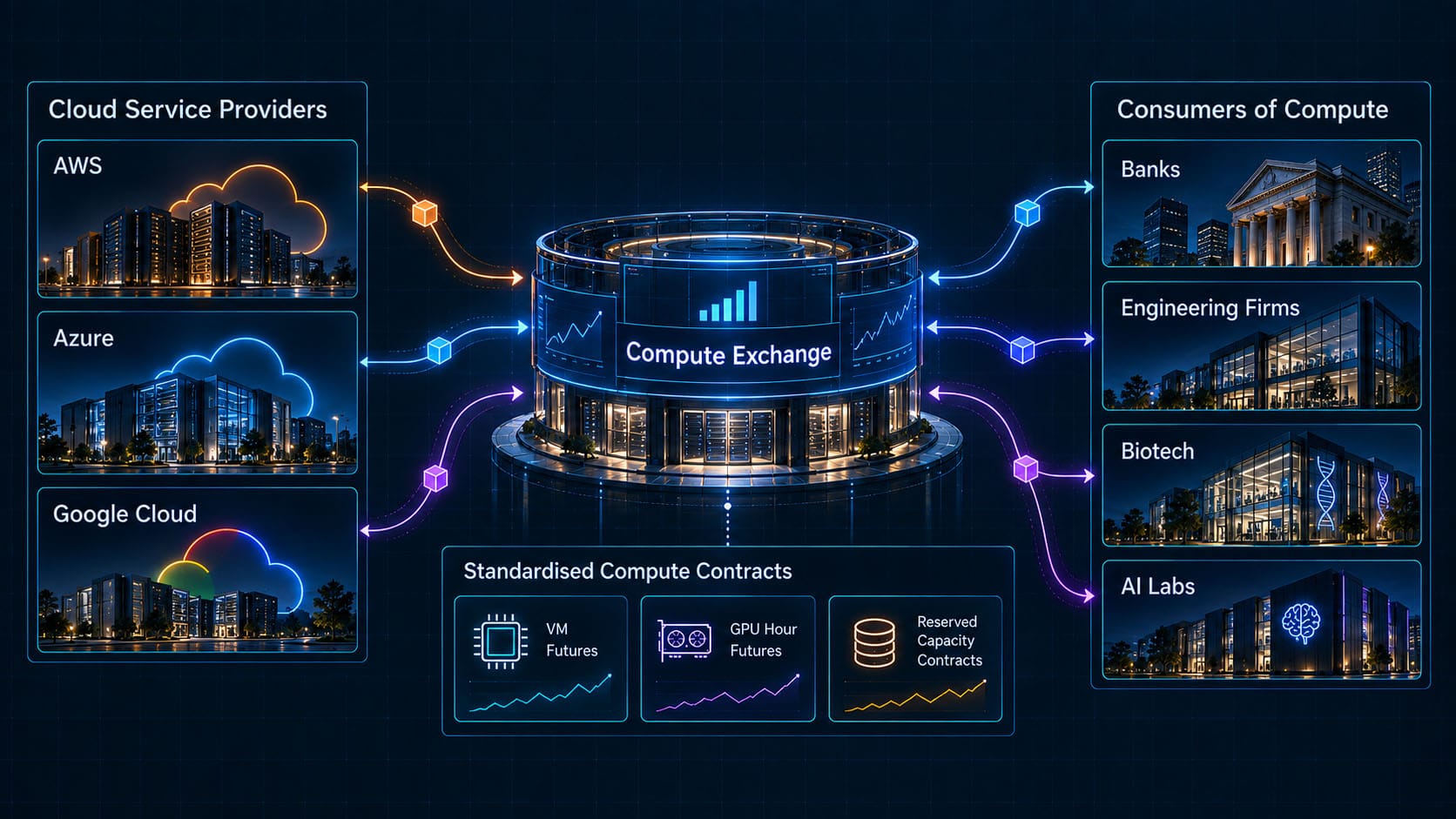
Commodity markets allow the exchange of both futures contracts and options to enable this. The farmer and the miller can agree a price for wheat in 6 months time once its been harvested. Both gain certainty in exchange for a potential upside or downside in price. This certainty can also enable increased investment within the business. The ability to define your cost base or your revenues allows more confidence in other expenses (or an earlier pullback in costs and investments). It may even allow either side to secure loans on the basis of a more certain future income. Price certainly isn’t just a luxury but rather something many parts of our economy now depend upon to function.
Nvidia is doing something similar. Sort of. They aren’t worried about uncertainty in the price of new GPUs in 6 months. They seem to be able to set pretty much whatever price they like on that right now.
What they are a little more worried about is the resale price of those GPUs in 5 years once they are used and the initial buyer wants to sell them. But why does Nvidia care about the resale price? Surely that becomes a problem for the purchaser of said GPUs.
They care because the buyers of the GPUs will sometimes want to borrow money to buy them. Whoever lends the money to buy those GPUs though will want to know what they will be worth at the end of the loan period just in case the buyer doesn’t pay them back. If the bank that lent the money to the neo-cloud doesn’t get reimbursed, they want to know how much they will get on the open market for 5-year-old GPUs. The interest rate they set on that loan will then be a function of how much risk they are carrying.
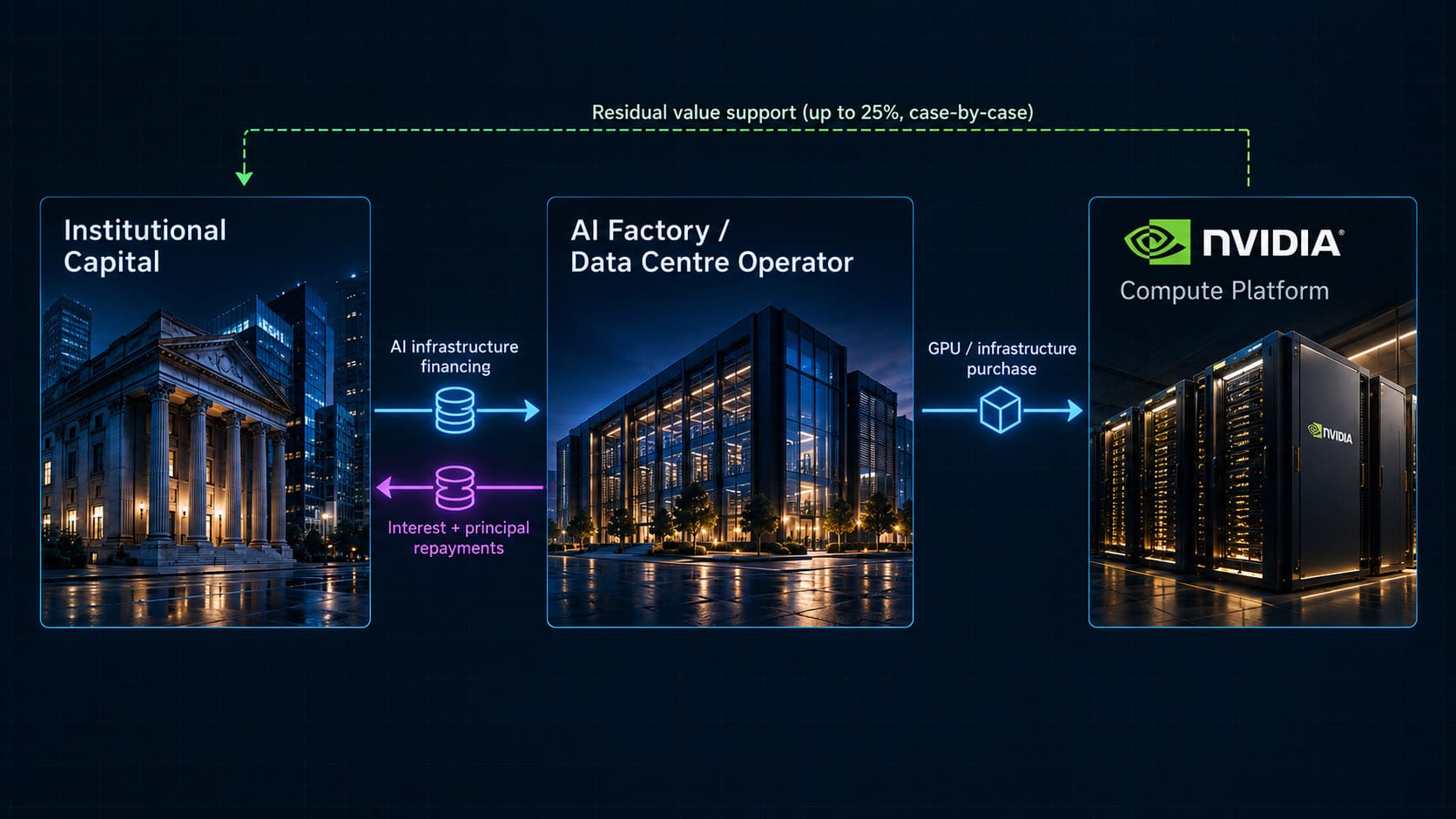
What Nvidia is trying to do, is to set a floor on the value of those GPUs by promising to pay at least 25% of the new price. This reduces the potential risk for lenders and thus increases the chances of them offering a loan and reducing the interest rate that is charged on it.
This isn’t all that novel either. Tesla has, in the past, tied the deprecation of its Model S to that of a Mercedes S[4] class to allow prospective customers to secure loans and reduce their monthly payments. This is essentially the same idea, just at a very different scale.
It’s really not clear to me what the new investable asset class is here. Are we talking about potentially trading those minimum guaranteed value GPU back debts like bonds in the future? Are we creating a paper GPU class akin to paper gold? Or are we simply creating a way for Nvidia to reduce the risk taken on by private credit in an attempt to quash the cries of circular financing without impacting Nvidia’s sales?
I grant you there is a similar desired outcome (future price certainty for a product), yet very different mechanism to achieve it and distinct end goals. The first allows two counterparties to trade and agree the price of a commodity in the future. The second is designed to facilitate the sale of goods today (using debt based financing) by backstopping a future value.
That’s not all commodity markets do
This is, of course, somewhat of a simplification of the nature and purpose of financial products in today’s world. A baker and a miller don’t need the Chicago Mercantile Exchange (CME) to create a standardised futures contract simply to agree a forward transaction between themselves. Why do we need the CME (and standardised contracts) in the middle? You can already purchase compute from AWS to be delivered at a future date. Why do we need to create compute market? Banks can already loan money to neo-clouds to buy GPUs, why does Nvidia want to create a new asset class?
Tesla tying the value of a Model S to a Mercedes S class didn’t create a new “investable asset class”, so why does Nvidia doing the same thing for its GPUs turn into a story about financial markets for AI compute?
The answer to both are a couple of critical functions served by modern financial markets, namely price discovery and liquidity.
If you’re new to the world of finance, let me explain what I mean by price discovery. If you’re an old hand, feel free to skip ahead a little. Despite what it sounds like, price discovery is not simply the ability to look up the price of something. It is not being able to pay Reuters and Bloomberg their rather expensive market data fees just to have the most up to date price for NVDA on the NASDAQ.
Rather, price discovery is the process by which we arrive at what that number (the price) is. Genuinely free and unmanipulated markets excel at putting a price on things. The exact mechanism by which we arrive at this number varies by product and the exchange but in reality, it is in fact never a single number. Though, for our purposes today and, for most reporting it is often simplified as such. The function of the marketplace is quite simply no different to your (at this point probably fictitious) local market. You’ll have a number of people offering something for sale, several people prepared to buy and when the two sides happen to agree on a price, the transaction takes place. Financial market places just allow this to happen at a scale and speed that you’re not used to and capture every bid, offer and transaction in the process. This is price discovery. All of those bids, offers and transactions are in fact the price(s) of the product.
And we need it because without this, who’s to say what a barrel of oil or a bushel of wheat is worth in 3 months time. With a significantly large number of participants price discovery is essentially a consensus mechanism. A way for to us to agree on the price of something.
The phrase “significantly large number of participants” above is a veritable Atlas holding up the sky though. If the only market participants are Nvidia selling GPUs and a small number of neo-clouds wanting to buy them the situation doesn’t really change. Especially with the information asymmetry that would exist in a scenario such as this (Nvidia sees all the bids and offers but each neo-cloud sees only the offer and their own bid).
To arrive at a better price consensus, we need more market participants, more transactions. More liquidity. This is the second important function financial products serve.
However, in order to do this, we first need something else very important. Fungibility.
Is it fungible?
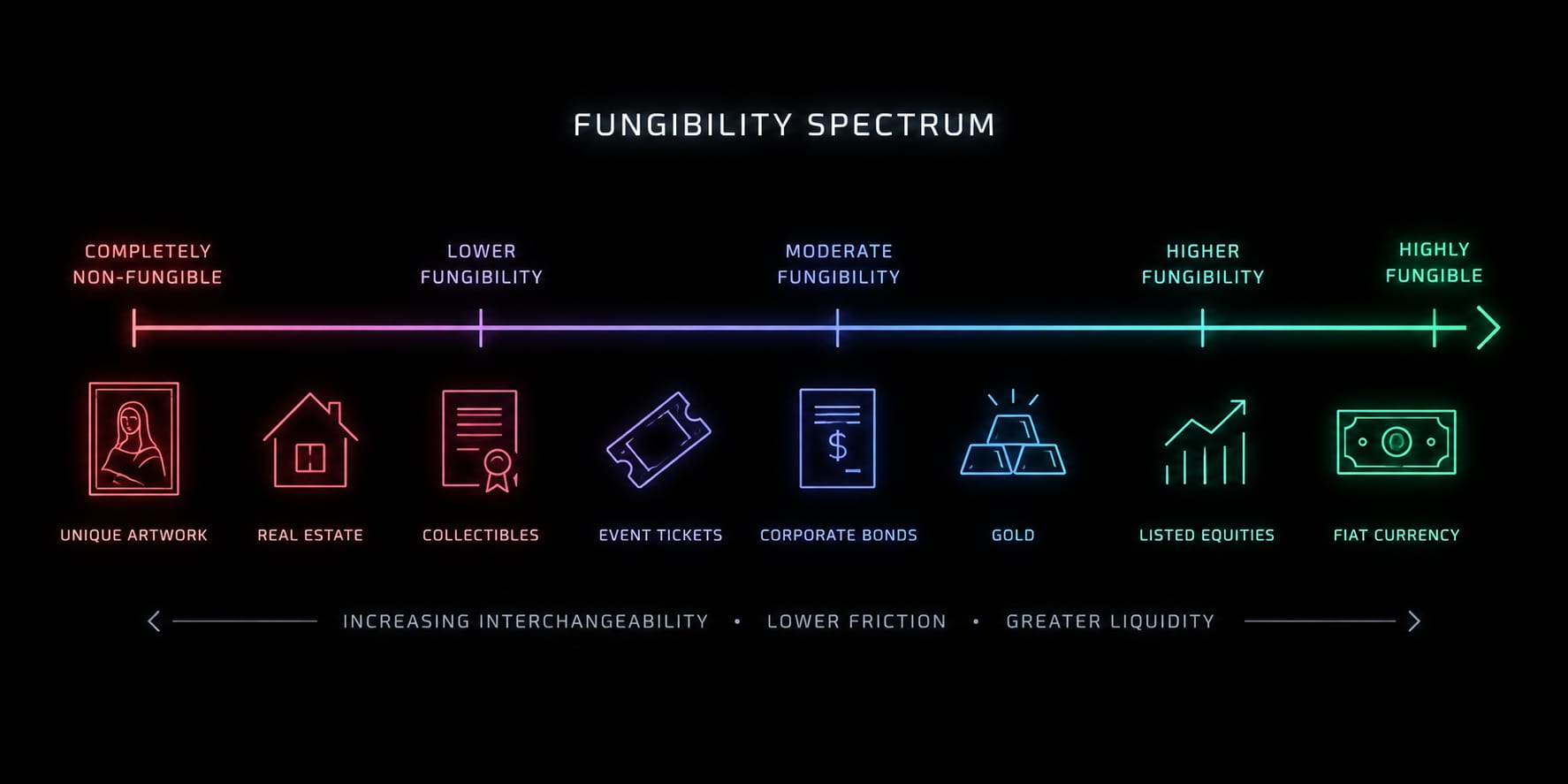
What does it mean for something to be fungible? The dictionary definition is kinda boring so let’s tell a little story instead. Let’s imagine you have the Mona Lisa hanging over your fireplace. Not a print. The original. If you were to sell it, you’d hold an auction of some description and we’d have a number of bids on it and ultimately the price at which it actually sold would give us its market value. Simples. That information is also pretty useless. Another Mona Lisa to sell doesn’t exist and if it did that would have materially affected the value of the one you just sold.
Now let’s repeat the above exercise with a single share of NVDA. Or your $1 (USD) bill. The sale price of either of those is incredibly useful information as there are literally billions of other shares or dollar bills that are exactly the same.
Currencies and exchange traded stocks are the most fungible assets in existence. One off items such as rare art are at the opposite end of the spectrum and completely non-fungible.
Yes, I know I could have used NFTs as an example here, I mean the word fungible is right there in the name… but I didn’t want to debase all the effort I’m putting into writing this by legitimising those as an asset :laugh.
If we’re talking about brand new GB300 MGX compute trays I think you could probably argue that these are pretty fungible. (Technically you’d be wrong due to chip to chip variation in performance but let’s ignore that for a moment). If we’re just talking about selling brand new GB300s as futures contracts then it’s a pretty fungible asset class.
But we’re not. We’re talking about a loan structured to use the GB300s as collateral and a guaranteed minimum value backed by Nvidia. We’re talking about the price of second had GB300s. While the resale market for chips isn’t quite as fickle as for your one of one custom specified BMW M3 with aftermarket rims it still doesn’t quite sit at the same level of fungibility as a new product. GPU lifetimes are directly impacted by their operating temperature and the number of dynamic pages of memory that have been retired/ offlined.
Nvidia’s blog states:
“NVIDIA DSX AI factories can run the world’s broadest range of AI models, modalities and algorithms — language, vision, speech, biology, physical AI and robotics. One NVIDIA AI factory can serve many customers and many workloads. That makes it flexible and fungible.”
This appears to be confusing fungible with compatible. These are not the same thing. I can substitute soy milk in my latte but it’s not fungible with cow’s milk (Editor’s note: Thanks NK!). An Intel AWS 64 vCPU VM in eu-west-1 may be compatible with an Intel Azure 64 vCPU VM in westeurope for some workloads but they are not fungible.
What of fungibility of compute in the way I refer to it? How easily can you swap using one cloud VM for another? Turns out, that even if you take the exact same VM type and size from one of the big three hyperscalers and run it in different regions you can see a fairly large variation in performance.
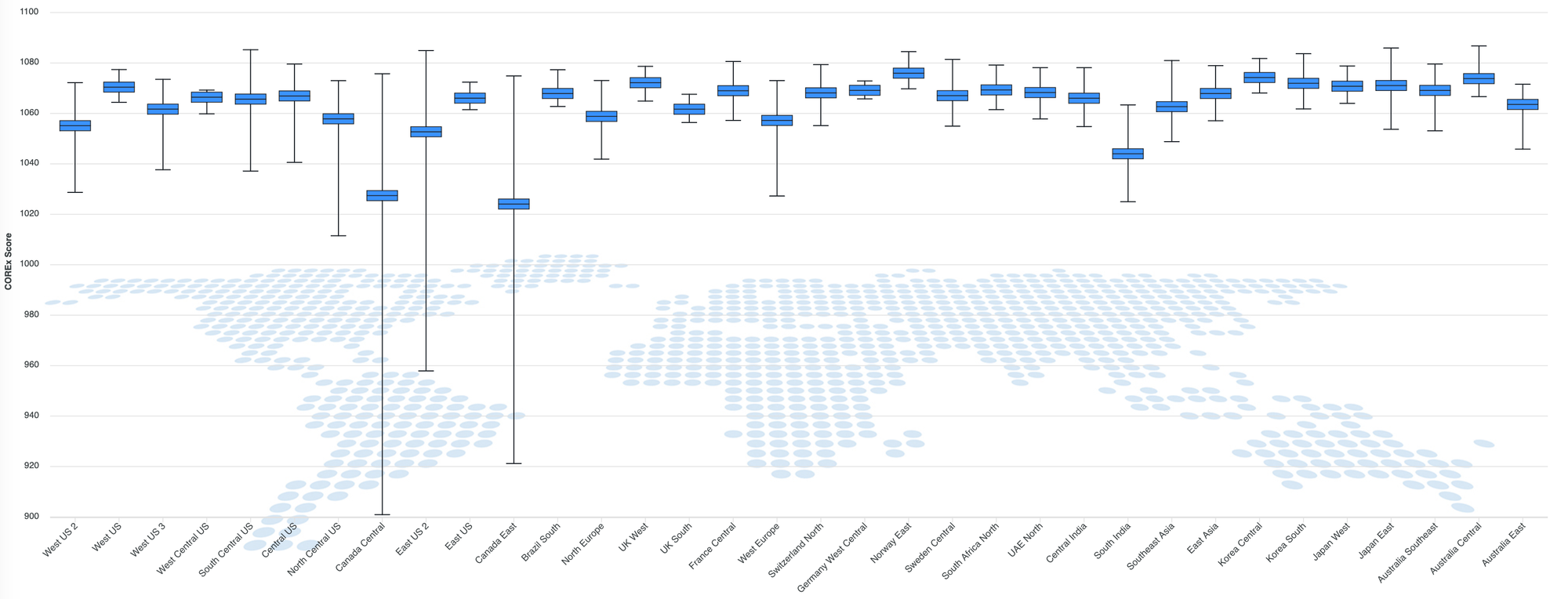
The chart above shows the performance of the same VM type and size on a financial risk analytics benchmark (COREx) across numerous regions. Not really a straight line is it.
Even this version of compute that you’d think should be fungible, isn’t. And that’s before we even consider things such as data locality and legal jurisdictions. That leaves little hope for the same CPU or GPU providing the same level of performance when it has been integrated by a different ODM, running with a different network architecture, different hypervisor, different cooling solutions, different ambient operating temperature… need I go on?
Then standardise everything to be fungible
The oil that comes out of the ground in West Texas is not the same as that being pumped out in Saudi Arabia which is different again to what is in the ground in Venezuela. Yet we still trade oil futures contracts on the CME right? What gives? If those aren’t fungible either but we’re happy to trade oil by the barrel on an exchange, why can’t we do the same with compute (in any flavour)?
The simple answer is that we can. The longer answer is that there’s a degree of information asymmetry to solve for first but that’s relatively easy in the grand scheme of things.
Whilst the oil price is often simplified to a single dollar value per barrel in the news, it actually trades as standardised futures contracts for something rather specific. The quoted headline price is generally the price for Brent Crude (from oil fields in the North Sea, UK) or WTI (from oil fields in West Texas). Crucially that is not the price of Venezuelan heavy oil (harder to refine than WTI or Brent) or even Saudi oil. There are other exchange and contracts for some varieties of oil such as the Gulf Mercantile Exchange and these generally track the WTI or Brent Crude. A similar situation exists for oil that is not even exchange traded. Its price will generally track (at a discount) one of the headline futures contracts.
In other words, oil is not a completely standardised market where all traded crude oil has to be the same. It is possible to apply a discount to a well agreed price based on the cost of refining the crude oil.
The exact same approach can apply to compute. Exchange traded compute, in any flavour, does not require a standardisation of compute. This is often cited as a reason for why compute markets are not viable. This simply isn’t true. What is required is the ability to value (or price discovery) of one type of compute relative to another. How much better is one VM than another (or one particular H100 card than another).
Given the chart I shared above showing the varying performance of the same cloud VM type across regions, it shouldn’t surprise to you learn that quantifying this is actually relatively easy. In fact, not only is it quantifiable, it is quantifiable for your exact workload and use case. Whilst the chart above used a standardised benchmark for the comparison, the exact same graph can be produced for your own code.
Which gives rise to a really interesting situation. The impact and variation on performance across different types of compute or regions for you may not be the same as it is for me. Guess what helps everyone figure out what each of those is worth. Yep. Free markets.
None of that brings more money into the game.
In the year 2024 the CME traded close to 250 billion barrels of oil (based on an average daily volume of 983,000 contracts for 1000 barrels each[5]).
What was the total volume of oil that was actually delivered (into Cushing the refinery that is stipulated in the futures contract)? 250 billion barrels? Nope. Not even 20 billion In fact not even 2 billion barrels.
A mere 317 million barrels[6]. Close to 800 times the actual quantity of oil delivered and refined was traded on the financial markets.
To be clear, this doesn’t mean that some oil was just never delivered. It means that the futures contract for that oil changed hands multiple times before it finally settled. In other words, the original buyer, A, sold to B who sold to C and so forth till someone bought it that actually wanted the oil and not to just resell the futures contract.
This massive increase in liquidity was enabled by transforming oil from a commodity that is produced by one party and consumed directly by another to a standardised well defined product (fungible) such that it became possible for people interested in gaining exposure to the oil price to easily purchase, and resell, the futures contract with no intention of ever taking physical delivery of the oil.
If price discovery is essentially a process of consensus, the accuracy of the price can be considered to be a function of the number of participants. Increasing the potential number of participants by reducing the number of options for sale (standardisation) therefore increases liquidity and price accuracy.
There are valid arguments that purely speculative market participants are simply skewing the price and I certainly have a lot of sympathy for that point of view. There are many factors that impact the propensity of a market to become too frothy or overly exposed to speculative transactions, one of them is the link to physical delivery.
Why we need to tie futures contracts to an eventual physical delivery
The physical delivery of the oil has to take place at some point[7]. These products are not completely divorced from the reality of the physical oil market. They are not a way to gain exposure to the price but never have to actually supply the oil or actually recieve it when the contract expires. This isn’t a derivative (or prediction market!) contract that settles purely based on price movement.
And while this may seem academic, it is in fact rather important in grounding the prices of commodities in reality.
During my time on the trading floors of various banks I came across multiple stories of trucks pulling up in front of the bank attempting to deliver coffee beans or pork bellies because a trader forgot or was unable to roll over a commodity contract before it expired. Or having to fire up a power station because the electricity traders were unable to exit a position. I’m sure at least some of these were just urban myths but it really wouldn’t surprise if the odd one was true.
More importantly, there are actual real world documented examples we can look at instead of relying on anecdotes and urban myths. (Though there is just something funny about a truck full of pork bellies pulling up in Canary Wharf or Wall Street and expecting to offload them).
On April 20th 2020, the price of a WTI oil futures contract became negative[8]. You could be paid to take the oil. A collapse in demand due to COVID-19 and a lack of storage capacity meant that expiring contracts for May 2020 had nowhere to go. If you could take away the oil rather than actually deliver it to Cushing you’d be paid to do so.
We see similar situations play out even in the domestic electricity market when overproduction (due to high levels of wind or sun combined with base load generation that is slow to change) leads to negative prices for consumers. You are literally paid to consume electricity in certain regions and time periods.
This hard coupling to a physical product tends to keep prices in check to some degree.
While the exact nature of the financial product Nvidia is proposing isn’t clear, it does at least appear to be tied to a physical transaction of GPUs. This is not something that can be said for the compute futures contracts being proposed by the likes of Kalshi[8] or Polymarket. Even more reputable indices such as those on Bloomberg by Silicon Data track only pricing with not only no physical delivery but also no market depth (how much compute is available at that price, is it one GPU or one thousand). In fairness, this is in no small part because how much compute is actually available is generally a closely guarded secret that neither cloud providers nor neo-clouds will reveal. Something a real physically delivered compute market could solve.
A compute market, as per my definition of it, would resemble in some regards the market for electricity where physical delivery relates to the ability to use a specific computer in a specific time window.
Why even bother?
Historically financial markets have evolved to meet the needs of the market participants, starting with the producers and consumers of the actual physical products. The evolution usually starts with relatively simple constructs such a futures contracts (as outlined above) and culminates in increasingly complex derivative products as the requirements progress from being those of the producers and consumer to being those of the investors and speculators.
We go from something relatively simple, such a standardised future delivery contract or a loan to purchase a home or GPUs for a data centre and eventually end up with collateralised debt obligations (CDOs). You know those famous incomprehensible financial constructs that were blamed for the 2008 financial crash.
It is rather telling that we have an influx of financial products designed to be able to invest and speculate on compute and data centres but not directly enabling the use of that compute by the people that need it.
None of the current crop of companies or products are focusing on enabling compute financial markets are doing anything to enable the physical delivery of that compute, to make that easier, to increase compatibility (allowing greater standardisation and fungibility).
Some of the largest users of compute (outside of frontier AI labs) are supercomputing clusters. You’d think if you wanted to enable them to use compute more easily, to be able to benefit from price discovery and certainty that financial products are supposed to provide you’d want to do something for them to actually be able to use that compute. There’s not much going on in that space though.
And it’s not because it’s a solved problem either. Far from it. Most users of compute are tied to a single region or a small number of regions, often with a single cloud provider. Adopting multi cloud, multi region compute is still a challenge for a whole host of reasons both technical and legal. If all anyone can use is AWS us-east-1 it doesn’t really matter what other compute you might want to trade on the financial markets.
And without that link back to physical delivery all we’re really building is another casino.
[1] https://blogs.nvidia.com/blog/nvidia-ai-factory-compute/
[2] https://cloudhpc.news/adventures-in-high-performance-computing/
[3] https://cloudhpc.news/compute-futures-are-here-sort-of/
[4] https://qz.com/70450/the-only-good-thing-about-teslas-new-financing-is-how-much-a-mercedes-is-worth
[8] https://www.eia.gov/todayinenergy/detail.php?id=43495&mod=article_inline