Why Cloud Migration Needs Enterprise Architecture Before Infrastructure
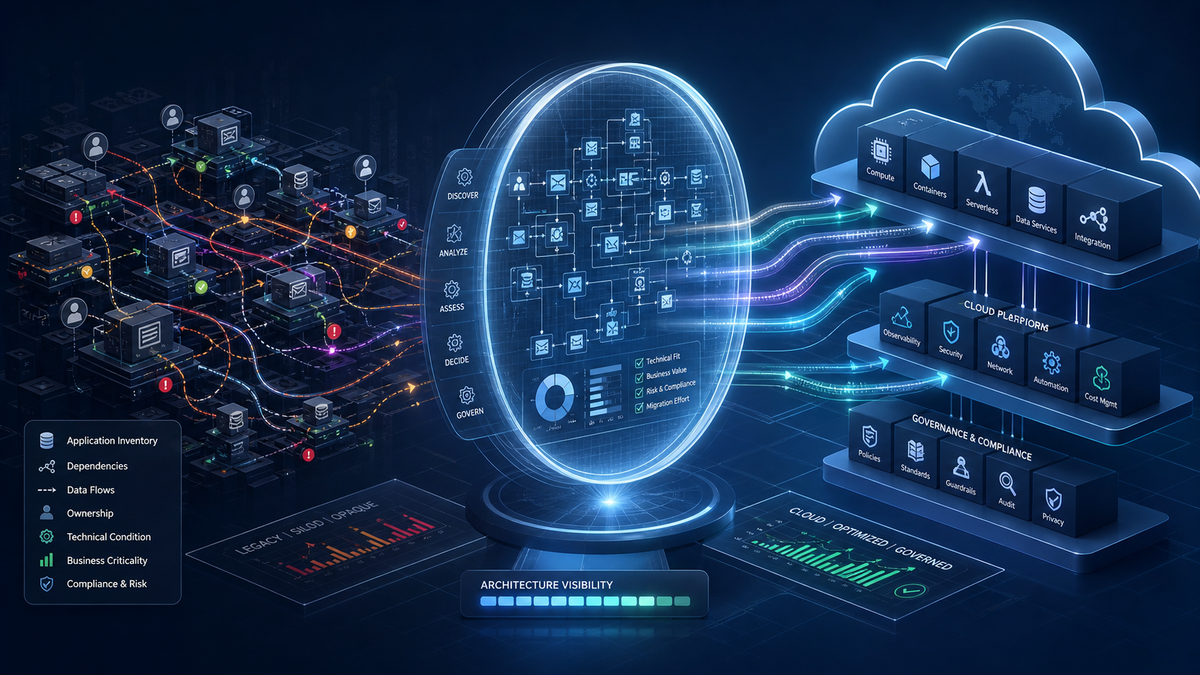
Cloud migration is often presented as an infrastructure challenge.
Move workloads. Select hosting patterns. Define landing zones. Build connectivity. Migrate servers. Optimise cost.
All of these things matter. But they are rarely the reason cloud migration programmes slow down, become expensive, or create unexpected risk.
The real problem is usually more fundamental, that is, organisations not understanding their application estates well enough to make confident migration decisions.
That is why cloud migration is not primarily an infrastructure problem. It is an architecture visibility problem.
This article follows my cloud migration case study last week, where Waltz was used to create a connected, evidence-based view of the application portfolio, supporting migration readiness, dependency mapping, sequencing, jurisdictional compliance, and post-migration assurance.
The spreadsheet problem
Typically, many cloud migration programmes begin with a spreadsheet.
At first, this feels practical. A list of applications is created. Owners are added where known. Hosting details are captured. A migration status column appears. Maybe there are fields for criticality, target platform, technical readiness, or migration wave.
Then the spreadsheet grows.
More teams add more columns. Definitions become incongruent. Ownership changes. Application names do not match across systems. Dependencies are recorded as notes rather than relationships. Business criticality is subjective. Technical condition is based on partial knowledge. Regulatory constraints are captured late, if at all.
Eventually, the spreadsheet stops being a decision-making tool and becomes a fragile reporting artefact.
The organisation may know that it has hundreds or thousands of applications, but it cannot confidently answer the questions that determine migration success:
· Which applications can move safely?
· Which applications should not move yet?
· Which systems depend on each other?
· Which applications are business-critical?
· Which are nearing end of life?
· Which have unresolved technical debt?
· Which handle sensitive or jurisdictionally constrained data?
· Which should be rehosted, replatformed, refactored, replaced, retained, or retired? (6 R’s)
Cloud migration becomes difficult not because the infrastructure team cannot build cloud environments, but because the enterprise lacks a sufficiently reliable architectural view of what needs to move, why it should move, how it connects, and what risk it carries.
Cloud decisions are architecture decisions
A cloud migration decision is rarely just a hosting decision.
Moving an application to the cloud may affect business operations, data flows, integration patterns, security posture, resilience assumptions, cost models, support responsibilities, and regulatory exposure.
For example, an application may look simple from an infrastructure perspective but be deeply embedded in business processes. Another may appear technically ready but depend on upstream batch feeds, downstream reporting platforms, or data stores with residency constraints. A third may be expensive to migrate but close to retirement, making migration poor value.
Without enterprise architecture context, these distinctions are hard to see.
That is where many programmes are vulnerable. They classify applications based on limited technical indicators rather than a fuller understanding of business value, lifecycle, ownership, dependency, condition, and risk.
The result is migration planning that feels active but is not necessarily intelligent. Teams move what is visible, easy, or politically urgent, rather than what makes sense in the context of the wider estate.
Enterprise architecture creates the decision model
Enterprise architecture gives cloud migration a structured decision model.
It connects applications to the business capabilities they support. It links systems to owners, stakeholders, lifecycle status, technology condition, data flows, upstream and downstream dependencies, and risk factors. It helps organisations understand not just what exists, but what each component means in context.
This is essential because different applications require different migration strategies.
Some applications are strong candidates for rehosting. Others may need replatforming to benefit from cloud-native services. Some should be refactored because their architecture is no longer fit for purpose. Others should be replaced by SaaS platforms or retired entirely because they no longer justify investment.
These decisions cannot be made well from infrastructure data alone.
They require a connected view of the estate.
Waltz as the architecture visibility layer
Waltz is valuable in cloud migration because it acts as a living map of the application landscape.
Rather than treating the estate as a static list, Waltz helps organisations model applications in relation to the wider enterprise. That includes ownership, lifecycle, business criticality, technical condition, data flows, dependencies, and regulatory considerations.
For cloud migration, this creates several practical advantages.
First, it provides a stronger application inventory. Teams can move beyond fragmented lists and establish a more consistent view of what exists, who owns it, and how important it is.
Second, it supports readiness assessment. Applications can be evaluated against business, technical, operational, and regulatory criteria rather than assessed only on hosting characteristics.
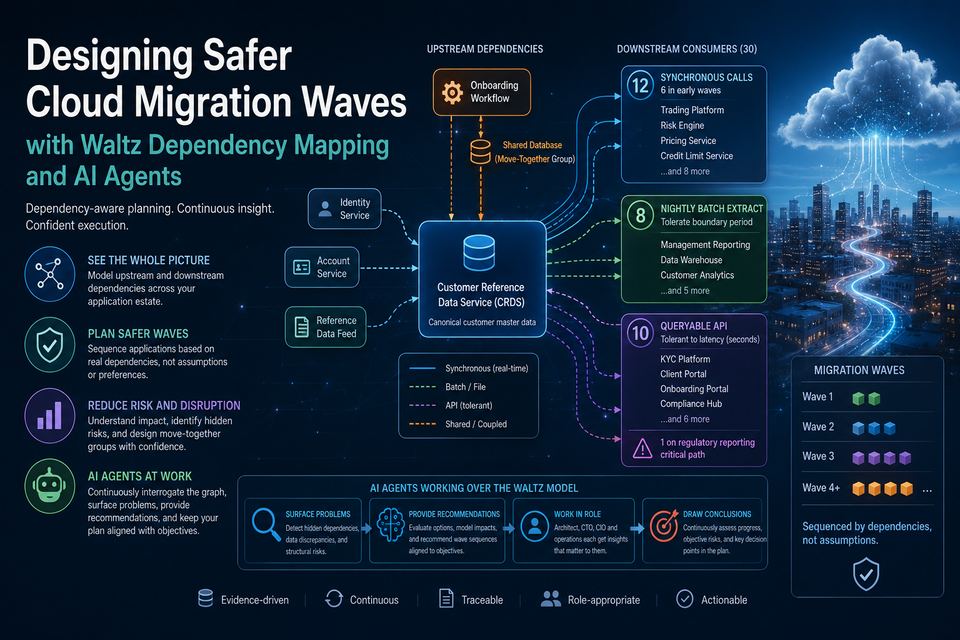
Third, it exposes dependencies. Migration waves can be planned around real relationships between systems, services, interfaces, and data flows, reducing the risk of disruption caused by hidden interconnections.
Fourth, it improves prioritisation. Organisations can distinguish between high-value migration candidates, applications requiring remediation, low-return systems, and applications better suited to retirement or replacement.
Fifth, it strengthens governance. Cloud decisions become traceable, explainable, and evidence-based, rather than dependent on undocumented assumptions.
Dependency visibility is where migration risk often hides
The most dangerous migration risks are often not inside the application being moved.
They sit around it.
An application may rely on another system for reference data. It may send feeds to reporting platforms. It may support business processes owned by multiple departments. It may use data that is subject to residency or regulatory constraints. It may be part of an operational chain that cannot tolerate downtime.
If these relationships are not visible, migration sequencing becomes guesswork.
This is why dependency mapping is not a secondary activity. It is central to migration planning.
A dependency-aware migration plan helps answer questions such as:
· Can this application move independently?
· What needs to move before it?
· What needs to move with it?
· Which interfaces need to be tested?
· Which business teams need to be involved?
· What is the blast radius if something goes wrong?
· Which controls must be validated after migration?
With Waltz, dependency information becomes part of the migration model rather than a set of disconnected notes. That allows architecture, engineering, business, and governance teams to work from a shared understanding of impact and sequencing.
The right migration strategy depends on context
Cloud migration is often simplified into a question of “move or do not move”.
That is too blunt.
A better question is: what is the right treatment for this application given its business role, technical condition, lifecycle position, dependency profile, and future value?
For some applications, a straightforward move may be appropriate. For others, migration should be delayed until technical debt is addressed. Some may need redesign before they can operate safely or efficiently in the cloud. Some may be better replaced. Others may not deserve further investment at all.
Enterprise architecture helps organisations avoid treating every application as equal.
This matters because cloud migration is also an investment allocation exercise. Time, budget, engineering capacity, and governance attention are limited. They should be focused where migration creates genuine value or reduces meaningful risk.
A structured application view helps prevent costly effort being spent on systems that are obsolete, poorly aligned to business priorities, or nearing retirement.
Governance does not end at go-live
Successful cloud migration is not complete when an application lands in the cloud.
For many organisations, especially those operating in regulated environments, the post-migration question is just as important:
Can we prove that the application landed in the right place, under the right controls, with the right data handling assumptions?
This is where architecture visibility becomes assurance.
If applications, data flows, ownership, jurisdictions, and landing-zone decisions are connected in a single model, the organisation can validate outcomes after migration. It can show why a decision was made, what constraints applied, and whether the final deployment aligns with those constraints.
That is a very different posture from simply tracking whether a workload has moved.
It turns migration from a delivery exercise into a governed transformation programme.
From migration checklist to architecture-led transformation
The organisations that struggle most with cloud migration are not always the ones with the weakest infrastructure capability.
Often, they are the ones with the weakest visibility.
They do not lack cloud ambition. They lack a reliable way to understand their estate, make consistent decisions, sequence change safely, and evidence outcomes.
That is why enterprise architecture should come before infrastructure execution.
Not as a theoretical exercise. Not as a heavyweight governance layer. But as the practical foundation for deciding what should move, what should change, what should stay, and what should stop.
Cloud migration needs landing zones, platforms, automation, security controls, and engineering discipline.
But before any of that can deliver value at scale, the organisation needs to understand its applications.
Because you cannot migrate what you do not understand.
And you cannot govern what you cannot see.
How HMx Labs helps
HMx Labs helps organisations use Waltz to bring structure, visibility, and governance to complex cloud migration programmes.
By creating a connected view of applications, ownership, lifecycle, business criticality, technical condition, dependencies, data flows, and regulatory constraints, HMx Labs helps migration teams move beyond spreadsheet-led planning and towards evidence-based decision-making.
The result is a migration programme that is easier to prioritise, safer to sequence, stronger to govern, and better aligned to business value.